Ranked first on cost effectiveness
Elite economists ranked micronutrients first among ways to help humanity when measured against their cost.
Our Projects
Adding a trace of iron to iodized salt — one of the most cost-effective ways to curb the world's most widespread form of malnutrition, now reaching an estimated 50+ million people.
Iron deficiency afflicts roughly 2 billion people globally, disproportionately women and children. That includes the majority of children in Africa, the majority of children and women under 50 in India, and 35% of women of reproductive age in the United States.
Its consequences reach well beyond tiredness. Iron deficiency reduces energy and cognition, increases maternal mortality, and reduces GDP by around 4% in many low- and middle-income countries.
Any fortification programme is only as good as its delivery vehicle. Salt is the best one we have.
Elite economists ranked micronutrients first among ways to help humanity when measured against their cost.
Salt is consumed in all cultures and geographies, in regular small daily quantities, and is centrally processed — even in low- and middle-income countries.
Iodized salt is consumed by around 6 billion people daily: several-fold more than any other fortified food.
From a single manufactured granule to salt already moving through national distribution.
DFS is made with an iron-containing granule that looks like a grain of salt. Our encapsulated ferrous fumarate (EFF) formulation preserves nutrient stability, bioavailability and consumer acceptability.
The granule is manufactured in India, then mixed with iodized salt at a 1:150 ratio at existing salt processing plants — no new production lines required.
Nutrient concentration can be dialled up as sodium intake decreases. EFF has more than 5× the bioavailability of ferrous sulfate, and the incremental cost is under USD 0.25 per person per year.
The programme has moved well past the pilot stage — governments and companies now run it themselves.
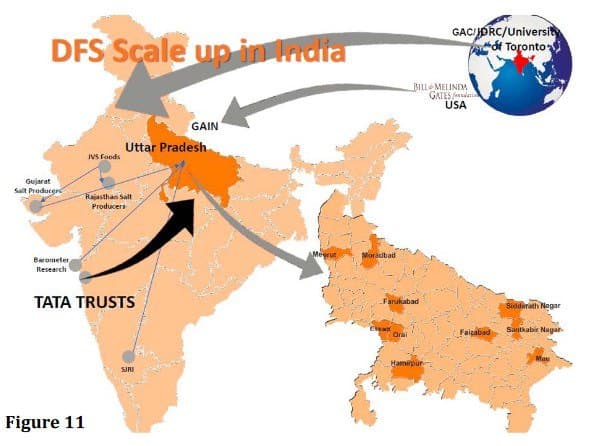
Distribution to an estimated 50+ million people and 10+ billion meals per year, mostly through safety nets in India.
Multiple state safety nets in India — PDS, MDM and ICDS — now wholly fund mass DFS purchase and distribution.
State governments are launching and funding DFS programmes on their own, without external prompting.
National brand ITC/Aashirvad is piloting DFS using our EFF formulation, and other companies sell DFS on a market basis.
A conglomerate in Peru and the government of Indonesia have reached out, alongside interest in Kenya (AMREF, Kisumu province) and from the African Union. Commercial rollout is ongoing in Argentina.
EFF DFS holds an estimated 90%+ share of the DFS market in India.
The results are measured, peer-reviewed, and hold up at population scale.
The work is carried out through the Fortified Salt Consortium, which includes the University of Toronto, the Open Source Pharma Foundation, and JVS Foods / Wella Nutrologicals (Jaipur), among others.
Two of the technology leads, Venkatesh Mannar and Levente Diosady, are Officers of the Order of Canada.
Meet the teamHelp advance open science through AI, global collaboration, and accessible healthcare. Volunteer or donate to make a lasting impact.